Pastor's Corner
Helping you grow in God’s Word, strengthen your daily walk, and deepen your personal time with Him.
Pastor’s Corner is designed to help you grow deeper in your relationship with God. Here you’ll find study resources, biblical insight, and practical teaching to strengthen your walk, develop your faith, and enrich your personal time with God. Whether you’re new in your journey or continuing to grow, these resources are here to guide and encourage you in the Word.
October 2026

The Replenished Request
October 2026
The Replenished Request
There’s something I do that I’m not proud of. Somebody offers to help and I hear myself say “no, I’m good” before I’ve even thought about it. It’s automatic. And about half the time I’m not good at all. I just don’t want to be the one standing there with my hand out.
I kept circling back to that this week while I was sitting in 2 Kings chapter 4.
A woman comes to Elisha with nothing. Her husband has died, she’s in debt, and the creditor is on his way to take her two sons. Elisha asks her a question I’ve read a hundred times and never really heard. What hast thou in the house?
She answers with the nothing. Thine handmaid hath not any thing in the house. And then, almost like an afterthought, save a pot of oil.
He builds the whole miracle on the three words she nearly didn’t bother saying.
Then he gives her the instruction, and it’s a strange one. Go borrow vessels from the neighbors. Empty ones. Not nice ones, not matching ones. Empty. And then four words I haven’t been able to shake all week. Borrow not a few.
So she does it. She shuts the door, and she starts pouring, and the oil keeps coming. Until verse 6.
There is not a vessel more. And the oil stayed.
Read that slowly. The oil didn’t run out. She ran out of containers. The pouring stopped on her end, not on God’s end. She didn’t quit receiving because heaven went dry. She quit because she stopped borrowing.
And here’s the detail that got me. The word the King James translates “borrow” in verse 3 is sha’al, which is just the ordinary Hebrew word for ask. Go, ask thee vessels. The asking and the filling aren’t two ideas we’re setting next to each other. They’re one sentence in the original.
Now hold that next to Joel 2, because most of us stop in the wrong place.
Verse 25 is the one we quote. I will restore to you the years that the locust hath eaten. We love that verse. We put it on things. But keep reading. Verse 26 says they’ll eat in plenty and be satisfied, and that’s the refilling, right on the heels of the repayment. Then verse 28 opens with a word I read past my whole life.
Afterward.
After the restoring. After the plenty. After the shame is gone. Then I will pour out my spirit.
Which means all the repair work God has been doing in you this season was never the finish line. He was clearing a place to pour.
So let me ask you what Elisha asked her. What’s in your house? Not what you lost. What’s left.
And then the harder question. What are you actually asking Him for? Because Jesus said it plainly, and when He finished that sentence in Luke 11, out of everything a Father could hand a child who asks, He named the Holy Spirit.
Peter learned this the hard way. His own mouth emptied him three times on a cold night, and he believed the calling went out with the words. Fifty days later he’s the one on his feet in Jerusalem explaining what God is pouring out. God didn’t forgive him quietly in a corner. God put him in front of a city.
Come Sunday with something to ask for. Not a mood. A request, named out loud. Bring vessels, and don’t bring a few.
“Ask, and ye shall receive, that your joy may be full.” — John 16:24
New life starts here.
Pastor Andrew Chung-Ying
Life Church of New Jersey

REMOVE
October 2026
I kept a shirt in my closet far too long.
It had one stain right in front, and I was determined to get it out. I pretreated it. I washed it on hot. I held it up to the window to check, saw it was still there, and did it all over again. I did that more times than I want to admit and through it all, I never once considered that the answer might not be a better detergent.
I thought about that shirt this week while I was sitting in Zechariah chapter 3.
Zechariah sees a vision. Joshua the high priest stands before the angel of the Lord, and Satan stands at his right hand to resist him which is what an accuser does, and an accuser needs something to point at. He had something. Verse 3 says it plainly: Now Joshua was clothed with filthy garments, and stood before the angel.
Understand who that is. That is not a backslider. That is the high priest. He is in his office, standing in his place, doing his job and he is filthy. You can be in position and still be in the garment.
Now watch what God does, because it is not what we would do.
First, Joshua says nothing. Not in the entire vision. He does not defend himself, explain himself, or promise to do better. God says, The LORD rebuke thee, O Satan. God does the arguing.
Second—and this is the part that finally took the shirt off my back God never addresses the filth to Joshua at all. He speaks over his head to those standing there: Take away these filthy garments f
And they did not wash them.
They took them off.
There is no scrubbing anywhere in that passage. There is a removal, and then a replacement: Behold, I have caused thine iniquity to pass from thee, and I will clothe thee with change of raiment. And then in verse 5 they set a fair miter on his head the high priest's headpiece, with HOLINESS TO THE LORD engraved on the plate of it. God did not only cover him. God put his identity back on his head.
Here is why I am writing this to you.
Some of us have been working on a stain we were supposed to take off. We have been pretreating it for years. Underneath all that effort is a quiet belief that if we can clean it enough, we will finally be acceptable, a kind of faith, but faith in the detergent.
Shame will do that to you. Guilt says I did something bad, and it walks you toward an altar. Shame says I am bad, and it walks you into the bushes. That is the oldest difference in Scripture. In the garden, Adam didn't say, "I sinned." He said, I was afraid, because I was naked; and I hid myself.
And I have to be honest about one more thing. Sometimes God takes it off us, and we go back and get it. Peter wrote about that—the sow that was washed, then wallowed in the mire. Notice he says she was washed. The washing was real. She went back anyway. Being cleaned and staying clean are two different works, and that's what we actually live.
In the second
Why do we put it back on? Because it is familiar. We have worn it long enough to know how to move in it.
So let me say to somebody what I needed said to me about that shirt. It is not your identity. It is not your story. It is not your future. And whatever came down your family line the name, the reputation, the thing nobody discusses at the table it doesn't have to be handed to the next one.
God does not shame you. He is not standing over you holding the stain. He removes, and then He re-clothes.
Come Sunday ready to take something off.
"Behold, I have caused thine iniquity to pass from thee, and I will clothe thee with change of raiment." — Zechariah 3:4
New life starts here.
Pastor Andrew Chung-Ying
Life Church of New Jersey
September 2026

Revive
September 2026
Our house has a plant on the kitchen windowsill that I forgot about for most of August. By the time I noticed it, the leaves had curled up brown and the soil had pulled away from the sides of the pot. I almost threw it out. Instead I soaked it, set it back in the sun, and walked away not expecting much. A week later there was one green shoot coming up out of what I had written off as dead.
That is what revival means. We usually use the word for an event: a banner out front, a guest preacher, a week of services, altars full of new converts. I thank God for every one of those nights. But look closely at the word. Re: again. Vive: to live. To revive is to live again, and you can only live again if you were alive before.
That's why every revival prayer in Scripture comes from God's own people. "Wilt thou not revive us again: that thy people may rejoice in thee?" When God took Ezekiel to the valley of dry bones, He didn't show him a pagan graveyard. He said, "These bones are the whole house of Israel."
And there is a line in that chapter I can't get past. The bones came together, the sinews and flesh and skin came on them, and they looked like people again. Then the verse says, "but there was no breath in them."
You can get your life back in order and still not be alive. A church can have a building, a schedule and a sound system and still not have breath. Order is good, but only breath is life.
So this is a revival season, and it starts on the inside. David encouraged himself in the Lord at Ziklag long before he recovered all. Peter couldn't face a servant girl until the Holy Ghost came in, and then he stood up in front of Jerusalem and three thousand souls came in. What burns in you is what spreads from you.
Revive me. Revive us. Revive all.
"And shall put my spirit in you, and ye shall live." — Ezekiel 37:14
Tis the RE-Season. New life starts here.
— Pastor Andrew Chung-Ying, Life Church of New Jersey

Re-SEASON Part 2: Re-Member ME
September 2026
PASTOR'S CORNER
Re-Member Me
There is a prefix I have not talked about yet.
We have been sitting in RE all season. Restore. Rebuild. Renew. Revive. Two letters out of the Latin that mean back, and again.
But there is a second prefix at work in a life, and it runs the other direction. It is DIS. It means apart. Asunder. Away.
Disconnect. Discourage. Disappoint. Disown. Disgrace. Disqualify.
Here is what the two of them have in common, and it is the whole thing I want you to see this week. Neither one can stand alone. A prefix has no life of its own. It has to attach itself to something that already exists.
Which means you cannot disconnect what was never connected. You cannot discourage a man who never had courage. And you cannot dis-member a body that was never assembled.
So hear me. The devil has never written a word in his life. He has only ever edited one. He is not an author. He is a prefix.
Look at how he works. In Matthew 4 he quotes Psalm 91 to Jesus — He shall give his angels charge concerning thee — and he leaves four words out. To keep thee in all thy ways. Go read the Psalm for yourself. The entire protection of that verse was in the clause he cut. He did not cancel the word. He carried pieces of it off and hoped nobody would go back and read the rest.
He is still doing it. He can quote your Bible. He can quote the word that was spoken over you at an altar three years ago — at two in the morning, with pieces missing.
And that is what our memories look like after he has handled them. Not a photograph. A pile. Broken dreams. Broken moments. Things started and never finished. Ezekiel stood in a valley and heard them say it out loud: our bones are dried, and our hope is lost — we are cut off for our parts.
That is not discouragement. That is dismemberment.
So let me say it plainly to somebody reading this. You are not disqualified. You are dis-membered. And DIS is a prefix, which means somebody did that to you. It was not your original condition. There was a body before there were parts.
Now hear what God does with that.
The night before the cross, Jesus told Peter that Satan had asked for him. Then He said, But I have prayed for thee, that thy faith fail not. He did not pray that Peter would not fall. He prayed that the light would not go out. And He said when thou art converted — not if. The comeback was on the calendar before the failure ever happened.
Three days later an angel at an empty tomb said, tell his disciples and Peter. Two words that were not necessary — unless heaven knew Peter no longer believed he belonged in that category. He had denied Him. He had cursed and sworn. And God still said his name out loud at a resurrection.
That is who we serve. He forgets your sins — I will not remember thy sins — but of you He says, yet will I not forget thee. Behold, I have graven thee upon the palms of my hands. He did not write your name somewhere it could be lost. He cut it into His own hands.
So come this week with three words. It is the prayer of a thief who had nothing left, and it got the fastest answer in the Gospels.
Lord, re-member me.
Bring back every word You gave me. The ones he quoted with pieces missing — put the pieces back. Set bone to bone. And then breathe.
New life starts here.
Pastor Andrew Chung-Ying
Life Church of New Jersey

Reseason
September 2026
There is a word in our language that is only two letters long, and it carries more hope in it than most full sentences. You will never find it standing by itself. It has no meaning at all until it attaches to something that already exists.
That word is RE.
It comes to us from the Latin, and it means two things at once: back, and again. Restore. Rebuild. Renew. Remember. Revive.
But here is what I want you to see, and it is the whole reason I am writing to you this week. A prefix cannot stand alone. Which means you cannot rebuild what was never built. You cannot restore what was never yours. You cannot revive what was never alive. And you cannot remember what was never known.
So when God begins to speak over your life in prefixes, He is not being poetic. He is testifying. Every RE is God going on record that something was there first — that there was an original, that there was a design, and that the purpose did not stop being the purpose just because the season went dark.
Before God ever says RE over your life, He has already said YES about your life.
I think of Peter. On the night before the cross, Jesus told him plainly that Satan had asked for him — asked to sift him like wheat. And the Lord said, "But I have prayed for thee, that thy faith fail not: and when thou art converted, strengthen thy brethren."
Notice what Jesus did not pray. He did not pray that Peter would not fall. He prayed that Peter's faith would not run out. And He did not say if thou art converted. He said when. The comeback was already on the calendar before the failure was ever committed.
Three days later, an angel stood at an empty tomb and said, "Tell his disciples and Peter." Why name him separately? Because Peter no longer believed he belonged in that category. So heaven put his name in the announcement.
Somebody reading this has quietly taken your own name off a list. You still come. You still sing. But somewhere inside, you have decided the category no longer includes you.
This is a reseason.
God is going to restore what the locust ate. He is going to replenish what ministry and grief and giving drained out of you. He is going to rebuild — and close the breaches before He raises the walls. He is going to remember, which in Scripture never means He simply thought about you; it means He moved. He is going to remove what cannot come with us into the next season, because before Lazarus came out, somebody had to take away the stone.
And then He is waiting on one thing. A request.
The enemy filed one over your life. Jesus filed a better one — and Hebrews tells us He ever liveth to make intercession. That prayer did not end at the resurrection. It is still being prayed over a name you thought was scratched off.
The Father honored the Intercessor.
Come on to church. Bring the dry bones to the valley and let the word be prophesied. Something is about to live again.
New life starts here.
Pastor Andrew Chung-Ying
Life Church of New Jersey
The Door They Couldn't Shut: Lesson 8 of From Pentecost to the Present
September 2026
The Door They Couldn't Shut
Pastor's Corner · Week 7 of From Pentecost to the Present
There is a man I want you to meet before Wednesday night.
His name was William Tyndale, and around the year 1522 he got into an argument with a learned churchman in England. The subject was whether ordinary people should be allowed to read the Bible in their own language. The churchman told him, in so many words, that the church's law mattered more than God's law.
And Tyndale said something back that I have not been able to shake for weeks.
He said that if God spared his life, he would make sure a boy who drove a plough knew more of the Scripture than that man did.
A plough boy. Not a scholar. Not a priest. A teenager with mud on his boots and dirt under his fingernails, walking behind an animal all day in a field. Tyndale looked at that boy and decided he had a right to the Word of God.
That was a crime. He had to leave England to do it. He translated the New Testament from Greek into English and had it printed in Germany, and the copies were smuggled back into England hidden in bales of cloth. The Bishop of London tried to stop it by buying up every copy he could find so he could burn them — and Tyndale took the money and printed a better edition.
In 1536 they caught him. They strangled him at the stake and burned his body. He was about forty-two years old.
Four years later, the King of England ordered an English Bible placed in every parish church in the country. It was mostly Tyndale's.
Why I want you in class this week
I know church history can sound like the kind of thing you take because it is good for you, like a vitamin. So let me tell you what this week is really about.
This week is about your Bible.
Not the doctrine of Scripture — your actual Bible. The one on your nightstand. The one in your bag. The one you scroll on your phone at a red light without thinking twice about it.
For about a thousand years, no ordinary Christian had one. The Scriptures existed in Latin, a language the people did not speak, read aloud by clergy in buildings where the average believer learned the faith from pictures in the windows. If you wanted to know what God said, you asked a man. And whatever he told you, that was that.
Then in the space of about one generation, that ended. And it ended because a handful of people decided the Word of God belonged to everybody, and were willing to be hunted, exiled, drowned, and burned over it.
Roughly eighty percent of the words in your King James New Testament are William Tyndale's. When you read "let there be light," or "the salt of the earth," or "fight the good fight" — that is a man who died in a Belgian prison yard so you could say those words in your own language.
I do not think you can hold that Book the same way once you know what it cost.
The honest part
Now here is where I have to be straight with you, because I would rather you hear it from me than from someone trying to shake your faith.
The Reformation did not get us back to the book of Acts.
Those men recovered enormous things. An open Bible. Salvation as a gift instead of a purchase. The truth that a mother praying at her kitchen table has exactly the same access to God as any clergyman alive. And a group of them — hunted by Catholics and Protestants alike — recovered the truth that baptism is for people who have repented and believed, not for infants who cannot do either.
But they never recovered the name in baptism. They read Acts 2:38 in the original Greek, in a printed book, in their own hands, and they did not see it. They never reopened the question of the Godhead. And not one of them expected the baptism of the Holy Ghost with the evidence of speaking in other tongues.
Three doors stayed shut. All three of them would open — but not for another three hundred and fifty years.
So we are not going to pretend these men were Apostolic. They were not. But we are also not going to sit in judgment on them from a comfortable pew four hundred years later. They finished the work they were given, and it cost most of them everything, and we are standing on ground they bought.
What has been sitting on me
The thing I cannot get past is this.
Brilliant men. Godly men. Courageous men — men who stood in front of emperors and would not flinch. They read the book of Acts their entire lives. They preached from it. They translated it. Some of them could quote it in three languages.
And they did not see Acts 2:38.
Not because they were stupid. Not because they were wicked. They just did not see it.
Which raises a question I have not been able to put down all month, and I am going to ask you on Wednesday, so you may as well start thinking about it now:
What is in my Bible that I have read a hundred times and still have not seen?
That question ought to keep all of us humble, and it ought to keep all of us reading.
Come Wednesday
We will cover Luther and the ninety-five theses — including whether he really nailed them to that door, because the honest answer is more interesting than the legend. We will cover the men who were drowned in a river in Zurich for baptizing believers. We will cover Münster, which was a disaster, and I will not hide it from you. And we will cover the Council of Trent, where Rome shut the door and locked it.
And we will finish with the ledger — what the Reformation gave back, what it never touched, and why that difference is the reason this church exists.
Bring your Bible. Bring your questions. Bring somebody.
"To the law and to the testimony: if they speak not according to this word, it is because there is no light in them." — Isaiah 8:20
Pastor Andrew Chung-Ying Life Church of New Jersey · Word of Life Apostolic Center
August 2026
Seek
August 2026
**Pastor's Corner**
I used to think I understood how a key works. You put it in the lock, you turn it, the door opens. Simple. Then a few years back the lock on our front door started sticking, and a locksmith showed me something I'd never thought about a key doesn't just fit a hole. It has to match a very specific pattern of pins inside the lock, each one lifted to a precise height, before the cylinder will even turn. The key isn't magic. It's authority, cut to match.
I've been thinking about that all week, because it's basically the whole sermon.
We say "in the name of Jesus" so often that it can start to feel like a phrase we tack onto the end of a prayer, the way you'd sign a letter. But that's not what Peter was doing at the temple gate when he told a man lame from birth to get up and walk. He wasn't using a phrase. He was using a key one cut to match, because the Man whose name he invoked is also fully God. That's why the religious leaders' first question wasn't "how did you do that," it was "by what power, or by what name, have ye done this?" To them, power and name were the same question. They were right.
That's why we spent the first half of this message just establishing who Jesus is before we said one word about power. Wonderful Counsellor. The mighty God. The everlasting Father. The Prince of Peace. Deity, robed in humanity not pretending to be a man, but actually becoming one, so that a name spoken by human lips could carry the full weight of heaven behind it.
And here's the part I don't want us to miss: He didn't leave that authority behind when He ascended. He sent the Comforter, so the same power that healed a lame man at the temple gate would keep operating through ordinary people like us — not for our own benefit, but so God's will gets done here, the way it's already done in heaven. And that power isn't meant to run ahead of character. Fruit first, then gifts — love before tongues, or the tongues are just noise. But when it's in the right order, Scripture doesn't leave us guessing whether the Spirit has really come. It gives us evidence. Three times, three different cities, one sign.
We want more of God's power. This week showed us where that power actually comes from not a technique we perform, but a Name we've come to know.
*"Neither is there salvation in any other: for there is none other name under heaven given among men, whereby we must be saved."
Acts 4:12*
**We Want More.**
WEEK 7 THE CHURCH IS MILITANT
August 2026
Pastor's Corner
When the Church Picked Up the Sword
If you were with us for the first part of Week 6, you already know this stretch of church history is heavy. We've watched a bishop in Rome grow into a Pope who could crown kings. We've watched the church split in half. We've watched doctrines with no basis in Scripture become official, mandatory belief.
This next part is harder still.
For the next portion of our study, we're going to walk through two things I wish weren't part of our history, but are: the Crusades, and the Inquisition. Nine separate military campaigns, spread across nearly two hundred years, launched in the name of Christ. And a system of church courts built to hunt down and punish people for what they privately believed.
I want to tell you why we're not skipping this, and I want to tell you why I think it actually matters for your faith today.
Why we're not skipping it
It would be easy to wave our hands at this part of history and move on to something more encouraging. But scholarly honesty — the same commitment that's guided this whole series — means we look at the hard chapters as clearly as we look at the good ones. If we only tell the parts of church history that make us feel good, we're not really teaching history. We're teaching a highlight reel.
So we're going to walk through all nine Crusades, one at a time — who led each one, what they were actually trying to accomplish, and what happened when they failed, which was almost every single time. We're going to define what the Inquisition actually was, why it started, and how the Spanish Inquisition, which most people have heard of, was a completely different and much later institution than the medieval one that came before it.
Why it matters for you
Here's the thing I want you to hold onto through all of it: every time the medieval church picked up the sword or the torturer's rack, it was measuring itself against a different standard than the one the apostles used. Jesus told Peter, in the garden, on the night of His arrest, to put his sword away — that all who take the sword will perish by it. The apostles conquered the Roman world with preaching, not weapons. They suffered martyrdom; they didn't inflict it.
That contrast is the whole point. An institution can do real good in one century and seriously betray its own foundation in another — both can be true about the same church at the same time. And the standard we measure it against never changes: not the sword, not the stake, not compulsion, but the pattern we see in Acts. Preaching. Patience. A willingness to suffer for the truth rather than force it on someone else.
I think there's something for us personally in that too. None of us are launching Crusades. But all of us are tempted, in smaller ways, to reach for pressure or control instead of patient, Spirit-led persuasion — with our kids, our coworkers, the people we're trying to reach for Christ. This section of history is a two-hundred-year cautionary tale about what happens when the church forgets that the gospel spreads by conviction, not compulsion.
Come ready for a hard lesson. But come expecting, like always, to walk away more grateful — grateful that even in the centuries the church got this so wrong, the apostolic pattern never actually disappeared. It was just waiting to be picked back up.
"Put up again thy sword into his place: for all they that take the sword shall perish with the sword." — Matthew 26:52
See you soon, Pastor Andrew
The Fruit Salad Is Finished — Now It's Time to Eat!
August 2026
Nine weeks ago, I told our church we were going to grow a fruit salad together. Love. Joy. Peace. Longsuffering. Kindness. Goodness. Faith. Meekness. Temperance. One bowl, nine flavors, all from the same Spirit.
Somewhere around week six, my wife Julie caught me staring into the fridge at an actual bowl of cut fruit she'd made for the kids' lunches, and she asked what I was thinking about. I told her the truth — I was thinking about how a fruit salad never stays a centerpiece for long. Somebody always eats it. That's the whole point of cutting it up in the first place. Nobody peels and slices a mango just so it can sit under glass and be admired.
That's where we land this week. For nine weeks it's been okay — good, even — for this to be about you. Is the fruit growing? Where are you stunted? What's the Spirit doing in your own soil? All of that was necessary. You can't serve what hasn't been grown.
But a finished fruit salad that never leaves the refrigerator was never actually finished. It was just refrigerated.
I keep coming back to Peter and John at the Gate Beautiful. A man who'd never walked a day in his life sat there begging, surrounded by more beauty than he could ever enter into. Peter didn't have silver or gold to give him — and he didn't pretend he did. "Such as I have give I thee." That was enough. It was always going to be enough, because it was actually his to give.
You have nine fruits the Spirit has been growing in you since we started this series. That's not nothing. That's exactly "such as you have." Somebody at your own gate — a coworker, a neighbor, someone in your own house — has been sitting there a long time, not expecting much from you, maybe not expecting anything at all. Fasten your eyes on them this week. Look at them the way Peter looked at that man. And then give them what you actually have.
It'll cost you something. It always does — that's the cutting. No fruit reaches anyone's mouth while it's still whole in the bowl. But that's exactly how its flavor gets out.
The party's already set. Everybody's bringing something. Bring the fruit salad.
"Then Peter said, Silver and gold have I none; but such as I have give I thee: In the name of Jesus Christ of Nazareth rise up and walk." — Acts 3:6, KJV
Fruit Salad Series — the harvest is grown to be given.
I Just Can't Help Myself... Only With JesusThe Fruit of the Spirit: Self-Control (Enkrateia)
August 2026
Pastor's Corner
I need to tell you something I've been sitting with all week: I picked up my phone Tuesday night "just to check the time," and forty minutes later I was still scrolling, feeling worse than when I started, and I couldn't have told you why I didn't just put it down. That's not a confession I planned to make from the pulpit, but it's the most honest place I know to start this week's message.
We've spent nine weeks in this fruit salad, and the whole time I think some of us were quietly waiting for the "hard" ones — the anger, the appetite, the greed. We got to those this week too. Esau and his bowl of stew. Noah and his vineyard. Achan and his wedge of gold buried under his tent. Old stories, old sins, easy to nod along to from a safe distance.
But the one that got me wasn't ancient. It was modern, and it was in my pocket. Doom scrolling doesn't feel like a temptation. Nobody preaches a fire-and-brimstone sermon about your phone. It just quietly trains you — every swipe a little gamble, every uncertain reward another small hit — until you've built a habit you never actually chose, one thumb-flick at a time. The Greeks had a word for that: akrasia. Knowing better, and doing it anyway. It's the exact opposite of the self-control we've been asking God to grow in us all series long.
Here's what I want you to hear, though — not as a scold, but as a fellow traveler who left his own coat behind more than once this week. Self-control was never meant to be something you grit out on your own. Joseph didn't outmuscle his temptation; he ran from it. Daniel didn't win in the moment; he'd already decided who he was before the tray was ever set down. And Jesus, hungrier and more pressured than any of us will ever be, didn't reach for willpower — He reached for what was already written in Him.
So if your version of "I can't help myself" this week was a screen, a second helping, a purchase you didn't need, or a temper you let loose — you're not disqualified from this fruit. You're exactly who it's for. The same Spirit that held Jesus together in the wilderness is not intimidated by your phone.
I can't help myself... only with Jesus, I can.
"Know ye not, that to whom ye yield yourselves servants to obey, his servants ye are to whom ye obey; whether of sin unto death, or of obedience unto righteousness?" — Romans 6:16

Heaven and Earth Collide
August 2026
Church family,
Something is colliding this season — and it's not a disaster, it's a visitation. Heaven's will is coming to invade our earth: our homes, our finances, our health, our future. Jesus taught us to pray, "Thy kingdom come, Thy will be done in earth, as it is in heaven" — not as a wish, but as a declaration that heaven has the right to govern everything we're walking through.
He is our daily bread. Every day we get to come to Him hungry and leave full — remembering what His body and blood purchased for us, and drawing fresh strength for whatever the day holds.
And this is a season of restoration. What the locust has eaten, God is restoring — not just the harvest, but the years. What was broken, He is repairing. What was stolen, He is bringing back. Nothing is too far gone. He already prepared your provision before you ever had the need — like the ram in the thicket, waiting on the mountain before Abraham ever took the knife in his hand. Your obedience releases what He has already reserved for you.
So hold on to this: whatever collision you're in the middle of right now, Heaven always wins. The plan of God will always trump the plan of the enemy.
Let your will be done, Lord. Let Your will be done.
Pastor Andrew
Gentle Jesus, Meek and Mild The Fruit of the Spirit: Prautes (Meekness)
August 2026
There's a prayer almost all of us learned before we could even understand it: *"Gentle Jesus, meek and mild, look upon a little child."* I said those words as a boy without knowing what "meek" meant. I doubt many of us did. Somewhere along the way, English let that word slide into something small — timid, soft, a person who gets walked on and says thank you for the footprints.
That was never what Scripture meant by it.
The Greek word behind "meekness" in Galatians 5:23 is *prautes*, and the ancient world used that same word for a wild horse that had been broken for battle. Not gentled into uselessness — trained. All the same fire, all the same power, now answering to the rider's hand. That's the fruit the Spirit wants to grow in you. Not less strength. Strength that finally submits.
Look at Jesus. He rode into Jerusalem on a borrowed donkey's colt when He could have entered as a conqueror. He stood silent before Pilate — not because He lacked an answer, but because He had the power to summon twelve legions of angels and chose not to use it. That's not weakness. That's the most restrained display of power this world has ever seen.
And yet meekness isn't a title you earn once. Moses was called the meekest man on the face of the earth — and in one moment of anger at the rock, he forfeited his own entrance into the Promised Land. If the meekest man who ever lived could lose it in a moment, none of us gets to coast.
Here's what I want you to walk away with: meekness and faith grow together. The more you actually trust God to fight your battles, defend your name, and write your ending, the less you'll feel the need to do it yourself. That's not resignation. That's rest.
So pray that old prayer again this week — but pray it like you mean it now. Ask the Lord to take whatever strength you've been running on your own reins and finally bring it under His hand.
*"Blessed are the meek: for they shall inherit the earth."* — Matthew 5:5
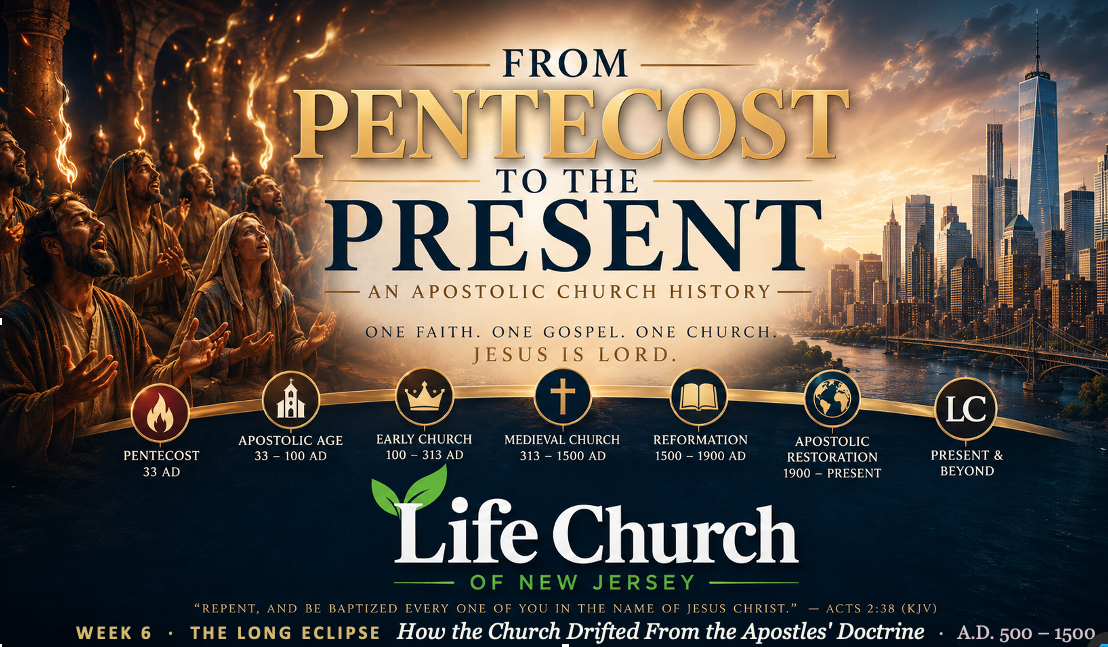
The Long Eclipse — Why We're Studying the Church's Darkest Thousand Years
August 2026
The Long Eclipse — Why We're Studying the Church's Darkest Thousand Years
If you've been following along with our Wednesday night study, you know we've spent the last several weeks in some pretty encouraging territory. We watched the apostles turn the world upside down. We watched the early church hold the line on who Jesus is, even under Roman persecution. It's been the kind of history that makes you proud to say you believe what the apostles believed.
This week is different, and I want to be honest with you about that before we even get started.
Week 6 covers the years A.D. 500 to 1500 — a thousand years historians often call the Middle Ages, or sometimes, less kindly, the "Dark Ages." And if I'm being straight with you, "dark" is a fair word for a lot of what happened. A bishop in Rome slowly grew into a "Pope" who could crown kings and threaten whole nations with damnation. The church split in half over a theological argument nobody today would recognize as worth splitting over. Doctrines with no basis anywhere in Scripture — purgatory, indulgences, prayers to dead saints — became official, mandatory belief. And twice in this thousand years, the church that once suffered persecution turned around and started handing it out, through the Crusades and the Inquisition.
I know some of you might read that and wonder: why are we spending a whole session on this? Isn't this exactly the kind of church history that makes people want to walk away from church altogether?
Here's my answer, and it's the same conviction that's driven this entire study from Week 1: I would rather you know the whole truth about where we came from than a comfortable version of it. Scholarly honesty has been our approach from the very beginning of this series — giving credit where the church got something right, and naming plainly where it got something wrong. That doesn't get easier in Week 6. If anything, it gets harder. But I believe our faith is strong enough to look straight at the hard parts of our own history without flinching, because our faith was never built on the church's track record in the first place. It was built on Jesus Christ, "the same yesterday, and to day, and for ever" (Hebrews 13:8) — and on the pattern His apostles left us in the book of Acts, which never stopped being true no matter how far the institution around it wandered.
And here's the part I really don't want you to miss: even in the darkest stretch of these thousand years, God never left Himself without a witness. This week you're going to meet three men most Christians have never heard preached on — Peter Waldo, John Wycliffe, and John Huss. A wealthy merchant who gave away everything to put the Gospels into the hands of ordinary people. An Oxford scholar who insisted Scripture outranks any pope, and who paid for it — his own bones were dug up and burned decades after he died. A Bohemian preacher who was promised safety, walked into a trap anyway, and refused to take back a single word of what he knew was true, even as they lit the fire.
None of these men are perfect models of everything we believe. But every one of them stood for the same thing this whole church-history series has been chasing from the start: that God's Word, not man's tradition, gets the final say. That conviction didn't start with us, and it didn't start with the Reformation either. It was already alive in Alpine valleys and English pulpits centuries before anybody had heard of Martin Luther.
So come Wednesday ready for a harder lesson than usual. But come expecting to leave more grateful, not less — grateful that the thread never actually broke, and grateful that we get to be part of the same story tonight.
"Repent, and be baptized every one of you in the name of Jesus Christ for the remission of sins, and ye shall receive the gift of the Holy Ghost." — Acts 2:38
See you Wednesday, Pastor Andrew
July 2026
After Nicaea: Why We're Still Talking About 4th-Century Councils
July 2026
Pastor's Corner
After Nicaea: Why We're Still Talking About 4th-Century Councils
There's a question I get asked more than almost any other when we teach church history: "Pastor, why does any of this matter? Councils, creeds, Greek words nobody uses anymore — what does that have to do with my walk with God?"
I understand the question. But here's what I've come to believe after years of studying this: you cannot understand what modern Christianity believes about God unless you understand what happened in the fourth and fifth centuries. The Trinity that most of the Christian world takes for granted today wasn't handed down whole from the apostles. It was built — piece by piece, argument by argument, council by council — and most believers have never been shown the receipts.
That's exactly what Weeks 5 and 6 of our series, From Pentecost to the Present, are about.
We pick up right where Nicaea (A.D. 325) left off — because Nicaea didn't settle nearly as much as most people assume. It answered one question: is Jesus truly God? It left the Holy Spirit's identity almost completely undefined, and the fight over that question consumed the church for another fifty years. We'll watch Arianism come roaring back with imperial backing, meet the Cappadocian Fathers who built the church's lasting vocabulary for God, and then sit with the Council of Constantinople (A.D. 381) — the council that actually finished the Nicene Creed and, for the first time in official church history, defined the complete doctrine of the Trinity.
Then we go further. We'll look honestly at the Council of Chalcedon (A.D. 451) and the controversy over Christ's two natures that split off entire branches of the ancient church — a division that, remarkably, is still unhealed sixteen centuries later.
And through all of it, we keep coming back to one thing: the apostles had already answered these questions plainly, centuries before any of these councils met. "God was manifest in the flesh" (1 Timothy 3:16) is our anchor verse for this whole unit, and it says more, more simply, than four centuries of Greek philosophical debate managed to say. We don't study this history to tear anyone down. We study it so we can hold our own confession — one God, revealed as Father, Son, and Holy Ghost, received through repentance, baptism in Jesus' name, and the gift of the Holy Ghost — with both conviction and honesty about where it came from and how it differs from what most churches teach today.
I hope you'll join us live for these two sessions, or catch up with the slides and notes afterward if you can't make it. This is some of the richest ground we'll cover in the whole series.
— Pastor Andrew Life Church of New Jersey · Word of Life Apostolic Center
FROM PENTECOST TO THE PRESENT · WEEK 5 · A.D. 325–500After Nicaea: Holding the Line
July 2026
Take the Study Guide Home
Every week I watch our class sessions run long — there's always more to say than there is time to say it in. That's exactly why we build a Member Study Guide for every unit, and this week I want to specifically ask you to actually use it, not just file it away.
The guide for Weeks 5 and 6 is bigger than usual, because the material earned it. It walks through everything we covered live — Nicaea's unfinished business, the Council of Constantinople and the actual finalizing of the Trinity doctrine, ten additional scriptures on the oneness of God beyond what we had time to read together in class, and a full section on the Council of Chalcedon and the ancient church split it caused that most believers have never heard of. It's laid out in a clean outline, with the Scripture printed right where you need it — not a fill-in-the-blank worksheet, but something you can actually read, underline, and come back to.
Here's my honest pastoral concern: it's easy to sit in a class, nod along, feel like you understood something, and then lose 80% of it by Thursday. The study guide is how you keep it. Read it with your spouse. Read it on your lunch break. Better yet — sit down with your kids or grandkids and walk through the "Words We'll Hear Tonight" glossary together, so they grow up knowing the difference between homoousios and hypostasis instead of being caught flat-footed the first time a well-meaning trinitarian friend asks them a hard question.
And that's really the heart of why this matters. We are Apostolic believers living in a world where almost every other Christian voice around us assumes the Trinity the way Constantinople and Chalcedon eventually defined it — three eternally distinct persons in one being. I want every person in this church to be able to explain, calmly and biblically, why we hold to the strict, unshared oneness of God revealed in Jesus Christ — without being unkind to the men who got some real things right along the way, and without flinching from where we believe they overreached. The discussion questions at the end of the guide are built for exactly that kind of conversation. Use them with a friend who sees it differently. Use them at your own kitchen table.
This is what "scholarly honesty" looks like in practice — not just something we say from the front, but something you get to carry home and hold in your own hands.
— Pastor Andrew Life Church of New Jersey · Word of Life Apostolic Center
Pistis Faithful to the Faithful One
July 2026
Faithful to the Faithful One
I still remember the sting of being let down by someone who promised they'd be there. Maybe you do too. Life happens, plans change, and the promise doesn't hold — and something in us quietly decides not to trust so easily next time.
Here's what I've had to relearn, over and over: faith and faithfulness aren't the same thing, even though they come from the same word in the Greek — pistis. Faith is what reaches forward and believes God for something you can't yet see. Faithfulness is what happens after — trust that's been tested by delay, disappointment, and time, and hasn't moved. You can have faith on day one. Faithfulness only gets proven by staying.
And on the days I haven't stayed as well as I should have — the days doubt had my feet moving when they should have had my knees bending — Scripture doesn't let me forget where the real anchor is:
"If we believe not, yet he abideth faithful: he cannot deny himself." — 2 Timothy 2:13
That's the whole gospel in one line. His faithfulness was never a reaction to mine. It's who He is. Every single day I've been standing, I've been standing on a faithfulness that started working long before mine ever caught up.
So this week, I'm not asking you to manufacture more willpower. I'm asking you to remember He's already been faithful to you — and let that be the ground you plant your feet on again.
"It is of the LORD's mercies that we are not consumed, because his compassions fail not. They are new every morning: great is thy faithfulness." — Lamentations 3:22-23, KJV
Pastor Andrew Chung-Ying
Life Church of New Jersey
Agathōsynē — Goodness Gracious
July 2026
The goodness of God has a funny way of hiding in plain sight — even in the words we use every day.
Have you ever stopped to think about how many times you've said "goodness gracious" without meaning a word of it? I hadn't either, until I looked into where that little phrase actually came from. Turns out, both of those words — "goodness" and "gracious" — started out as gentle, polite ways folks used to talk about God: His goodness, and His grace. Somewhere along the way, the reverence wore off, and all we kept was the reflex. We say it when we're surprised, when we're delighted, when we drop something on our foot — never once thinking we're quoting God's own character.
This week at Life Church, we're putting the theology back on that phrase. Agathōsynē — goodness — is the sixth fruit of the Spirit, and it's not the soft, forgettable virtue we sometimes make it out to be. It's goodness with a spine. It shows up as a kindness that costs you something, and sometimes it shows up as a hard, loving truth that costs you even more. It's the goodness Paul described as being "created in Christ Jesus unto good works" (Ephesians 2:10) — not something we manufacture to earn God's favor, but something we were rebuilt to produce because of it.
And here's what got me the most as I studied this week: David didn't write that goodness and mercy would be waiting up ahead for him someday. He wrote that they follow him — chasing him down, all the days of his life. Whatever season you've walked through, if you're still standing today, that is goodness that has been running after you the whole time, whether you noticed it or not.
So the next time those words slip out of your mouth, let them mean something. Let "goodness gracious" become a confession instead of a reflex — because His goodness really has been chasing you, and His grace really has been covering the distance every time you fell short.
"Surely goodness and mercy shall follow me all the days of my life: and I will dwell in the house of the LORD for ever." — Psalm 23:6 (KJV)
— Pastor Andrew Chung-Ying
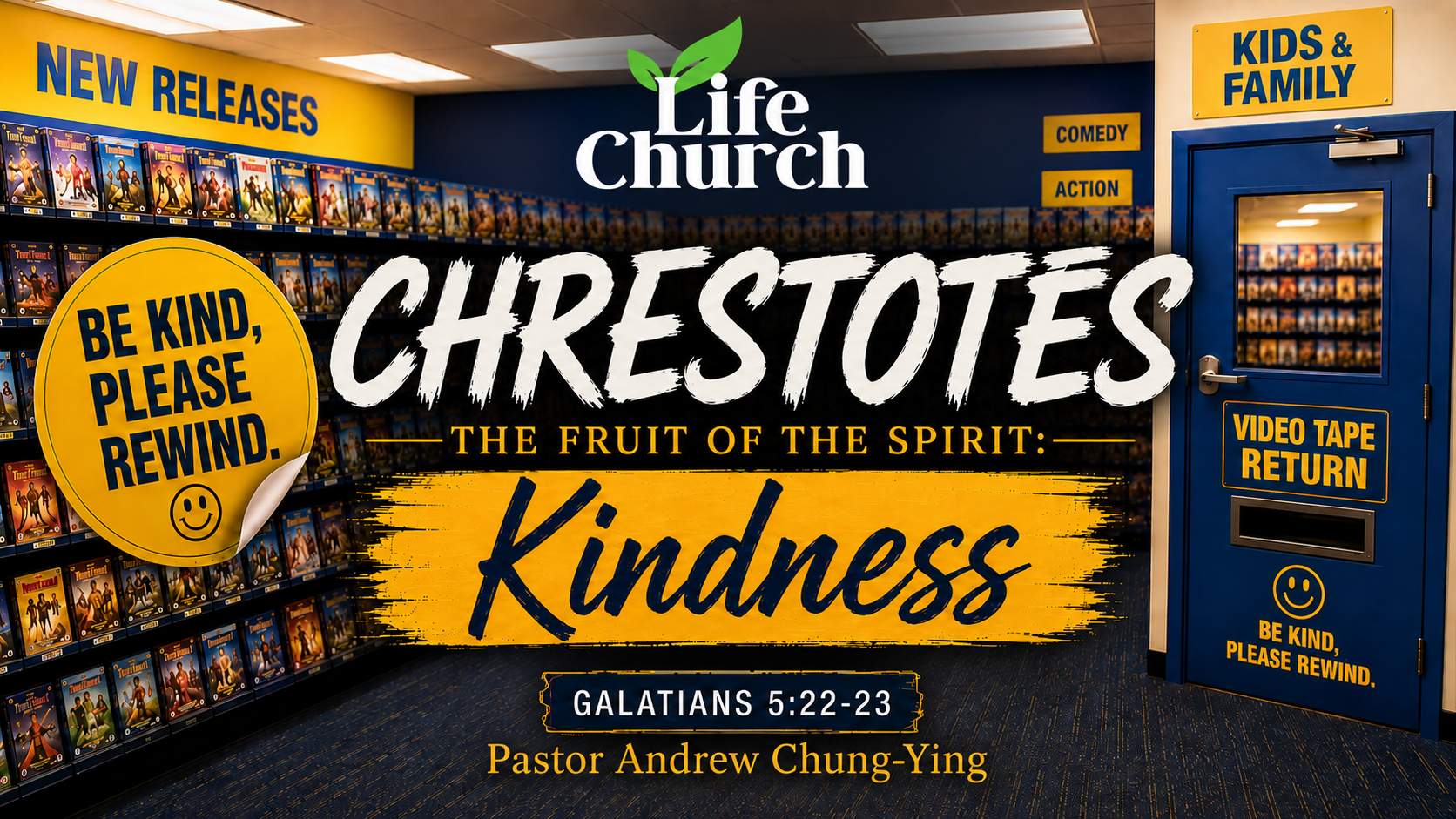
Chrēstotēs: The Fruit of Kindness
July 2026
PASTOR'S CORNER — WEEK 5
Fruit Salad Series | Chrēstotēs: The Fruit of Kindness
Five weeks in now. And this week I want to start with a memory instead of a verse.
Remember Blockbuster? Remember that little yellow sticker on every VHS case — "Be Kind, Please Rewind"? It wasn't a law. Nobody fined you for skipping it. It cost you nothing to ignore it, and it cost a total stranger everything when they sat down expecting a movie and got eighteen minutes of static instead.
That's kindness in a nutshell. It's the thing that costs you a little and blesses someone else a lot — and usually, you never even find out who they were.
This week in Fruit Salad, we tasted the fifth fruit: chrēstotēs, kindness.
Here's something I didn't expect to find so interesting until I dug into it — if you're reading Galatians 5:22 in your King James Bible, the word there isn't even "kindness." It's "gentleness." But that same Greek word, chrēstotēs, gets translated "goodness" in Romans 2:4, and "kindness" in Ephesians 2:7 and Titus 3:4. Same word, three different English words, because back in 1611, "gentle" meant something closer to noble, gracious goodness in action — not soft-spoken and mild the way we hear it today. The word didn't change. Our English did.
Why does that matter? Because Paul isn't describing a personality. He's describing something that moves. Something that acts.
Look at how Jesus actually lived it out. He didn't lead with a sermon — He led with compassion, and healed the sick, and then fed the five thousand off a boy's willingness to hand over his lunch. The Good Samaritan didn't preach to the man in the ditch — he bandaged him first, paid for his recovery first. Meet the need, then the door opens for the deeper witness. Nobody wants to hear that God cares about their soul from someone who never noticed they were hungry.
I also want to say something to some of you specifically. Maybe kindness was never modeled for you. Maybe home was hard, or the people who should have shown you love didn't. I want you to hear me: that does not disqualify you. Kindness is a fruit of the Spirit, not a family trait. You are not stuck reproducing what you were dealt. God plants this fresh in you, by His own Spirit, regardless of what you did or didn't receive growing up. You overcome evil with good — not by matching it.
And here's the part that should stop us in our tracks: nobody has seen God. But people see you. When you show kindness, His love finishes its sentence through your hands into somebody else's story. You are not doing extra credit for the Kingdom. You are His hands and His feet, touching people He is not physically standing in front of.
Be kind. Please rewind. Somebody's about to receive whatever you leave behind.
"No man hath seen God at any time. If we love one another, God dwelleth in us, and his love is perfected in us." — 1 John 4:12
— Pastor Andrew Chung-Ying
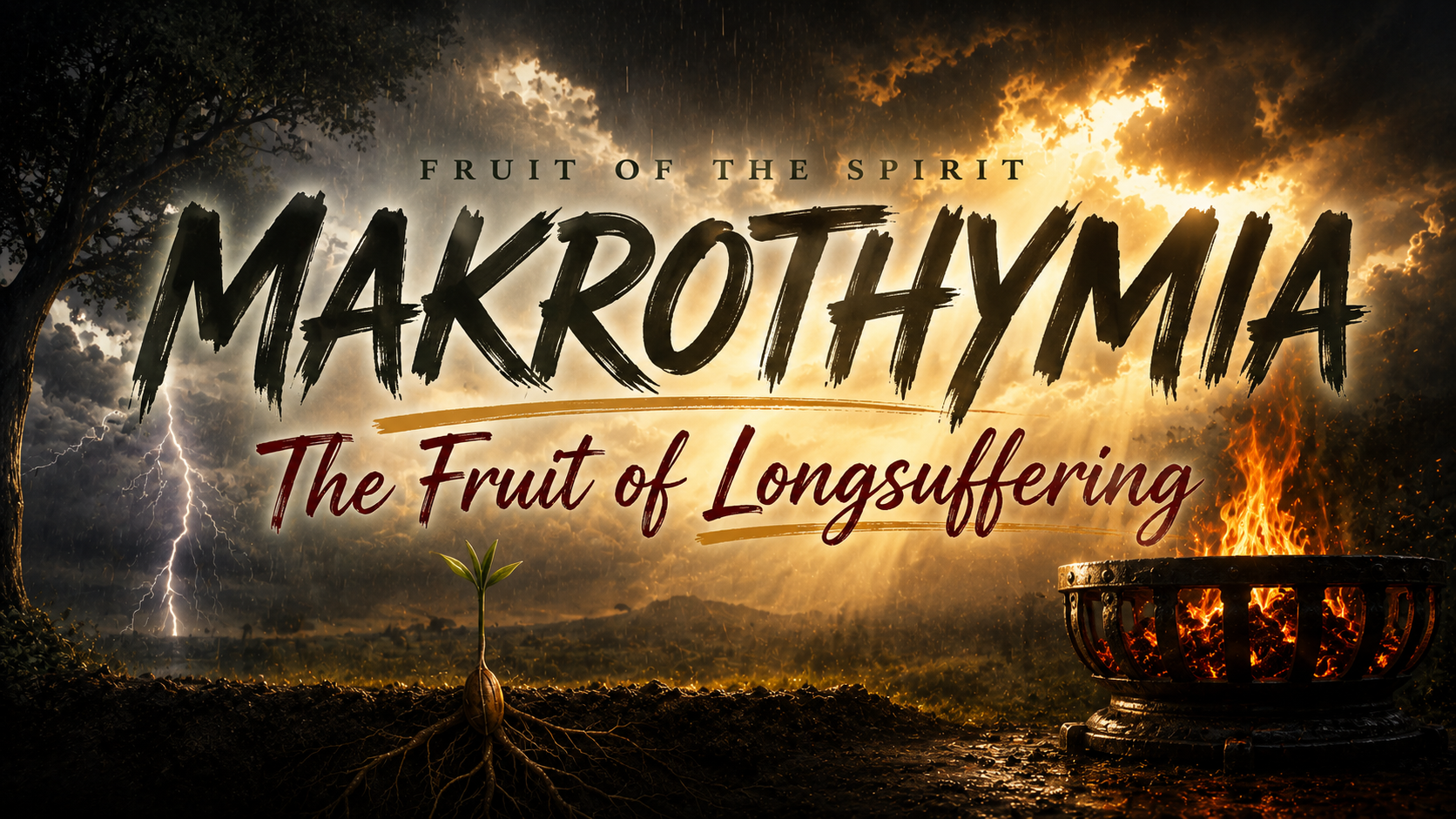
Makrothymia: The Fruit of Longsuffering
July 2026
PASTOR'S CORNER — WEEK 4
Fruit Salad Series | Makrothymia: The Fruit of Longsuffering
Four weeks in. And I want to ask you something before I tell you what we preached this Sunday.
Is there someone in your life you have been about to give up on?
A prodigal who has not come home yet. A relationship that has taken more from you than it has given back. A prayer you have been praying so long you can barely remember when you started. A promise from God that has not materialized yet — and some days you wonder if you heard Him right.
If any of that landed, this word was for you.
This week in our Fruit Salad series, we tasted the fourth flavor: makrothymia — longsuffering.
The Greek word is built from two parts: makros, meaning long, and thymos — the heat of the soul, the boiling point, the place where passion ignites. Put them together and you get long-boiling-point. Long-tempered. The capacity to absorb provocation, disappointment, and sustained delay without igniting.
It is not weakness. It is not passivity. It is not a personality type you either have or do not have. It is a fruit — which means it is grown in you by the Spirit, not inherited by temperament. And like every fruit we have tasted in this series, it does not grow on a separate vine. It grows from the same Source as agapē, charā, and eirēnē. Love is the root that feeds it. Joy is the fuel that sustains it. Peace is the steadiness that keeps it from collapsing under pressure.
We talked about the farmer in James 5. He plants what he cannot yet see. He waters ground that still looks like dirt. He does not dig up the seed every few days to check on it, and he does not abandon the field because the sky looks dry. He waits for both rains — the early rain that starts the process, and the latter rain that brings the harvest to full maturity. Between those two rains there is a long season that looks like nothing is happening. But the farmer knows what the untrained eye misses: the work is happening underground. Before the breakthrough is visible, the root system is forming.
Some of you are between rains right now. The early rain came — something started, something shifted, something was promised. But the latter rain, the full harvest, has not appeared yet.
Do not dig up the seed. Do not leave the field.
We also talked about the father in Luke 15. He did not chase his prodigal son into the far country. He waited. But his waiting was not passive. He was watching the road — every day, scanning the horizon for a silhouette he would recognize anywhere. And when that son appeared, still far off, still covered in evidence of his choices — the father ran.
That is makrothymia. Not passive sitting. Active watching, ready to run the moment the door opens.
And here is the part that I pray stays with you all week: before God ever asked you to be longsuffering toward anyone else, He was practicing it toward you. Every season you wandered. Every time you said not yet to what He was asking. Every delayed obedience and quiet compromise. Makrothymia — toward you. The goodness of God, Paul says, is what leads us to repentance. Not the hammer. The long patience. The steady bearing-with that never stopped watching the road.
Colossians 1:11 says we are strengthened with all might, according to His glorious power, unto all patience and longsuffering — with joyfulness. Not grim endurance. Not white-knuckled survival. Longsuffering with joyfulness. Because the Spirit supplies what the long season cannot take from you.
Stablish your heart. Tend the ground. Watch the road. Run the mile.
The latter rain is coming.
— Pastor Andrew
"The husbandman waiteth for the precious fruit of the earth, and hath long patience for it." — James 5:7
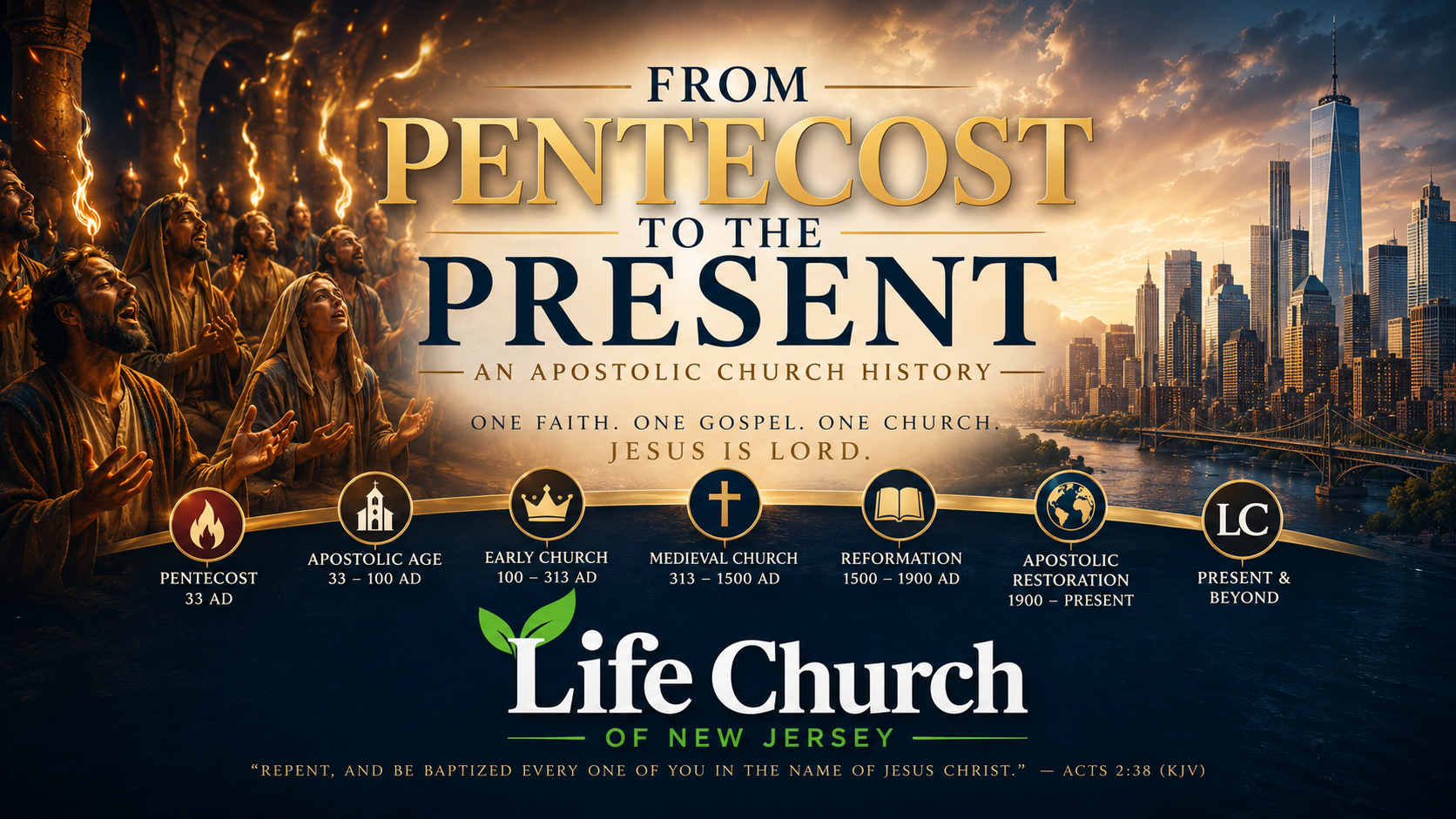
Outline for Week 3 When the Apostles Were Gone
July 2026
Why This Week's Study Matters
Imagine standing in the church at the close of the first century. The apostles are gone. Peter and Paul have been martyred in Rome. John, the last living voice who had leaned on the Lord's breast, has finally been laid to rest. And the question hanging in the air over every congregation is the one I want us to sit with this week: Can this faith survive without the men who started it?
That is where our journey through church history takes us next. This Wednesday, in Week 3 of From Pentecost to the Present, we step into the years A.D. 100 to 325 — a stretch I've titled "Holding the Faith Under Fire." And believe me, the title is not for drama's sake. In these two centuries the church was fighting for its life on two fronts at the same time.
On the outside, there was Rome. Ten waves of persecution. Believers thrown to lions, burned as torches, beheaded for refusing to call Caesar "lord." I'll tell you about Polycarp, an eighty-six-year-old man who could have walked free with a single word — and instead looked his executioner in the eye and said, "Eighty-six years I have served him, and he has done me no wrong. How can I blaspheme my King and Savior?" I promise you will not forget him.
But the fiercer battle was on the inside — and it was quieter. False teachers came in, not with swords but with ideas. They wanted to make the gospel sound sophisticated to the Greek philosophers of the day, and in the process they slowly began to change the way the church spoke about God Himself. We'll trace that drift carefully, all the way to the Council of Nicaea in A.D. 325, where — for the first time in history — an emperor who had not even been baptized sat down and presided over a council deciding Christian doctrine.
Here is what I most want you to walk away knowing: we are not the newcomers. When people tell us that baptism in Jesus' name and the oneness of God are some modern invention, this week is our answer. You'll meet the Monarchians — believers who held the line on the oneness of God — and you'll hear the man who invented the word "Trinity" admit, in his own writing, that the "simple majority of believers" in his day were on the oneness side. That's not our claim. That's his confession. We are not the strange offshoot of church history. We are the continuation of what the earliest church always believed.
To help you follow along, I've prepared a member study guide for this week. It walks through the entire lesson point by point — every Scripture printed out in full, every difficult term explained in plain language, and space in the margins for you to write down what the Lord speaks to you. You do not need to have read a single thing beforehand. Just bring your Bible, bring the guide, and come ready to learn. You can download it from the church website or pick up a printed copy before the service.
We'll gather on Zoom as always — so whether you're across town or across the country, pull up a chair at the table. Bring a friend. Bring your questions.
The gates of hell did not prevail against the church in Nero's day, or in Diocletian's, or at Nicaea. And they will not prevail against us either.
"And I say also unto thee, That thou art Peter, and upon this rock I will build my church; and the gates of hell shall not prevail against it." — Matthew 16:18 (KJV)
See you Wednesday.
— Pastor Andrew
June 2026
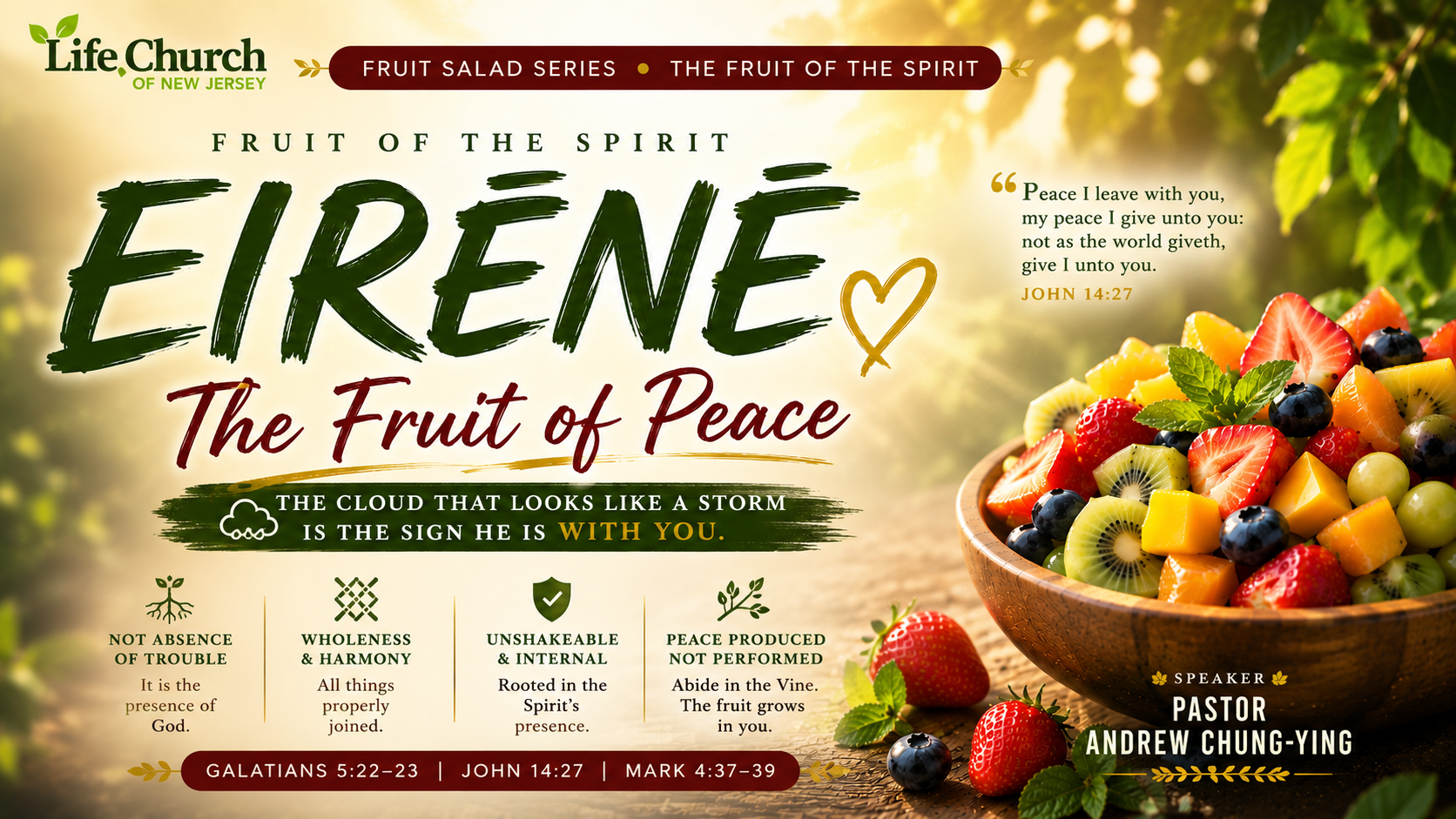
EIRĒNĒ The Fruit of Peace
June 2026
We are three weeks into our Fruit Salad series, and the bowl is already changing.
Week one we tasted agapē — love that does not rise and fall based on how people treat you, but chooses, stays, and gives even when it does not receive. Week two we tasted charā — joy that does not wait for your circumstances to improve before it shows up. Joy as a weapon, not a reward.
This week we tasted eirēnē — peace.
And I need you to know that eirēnē is not what most of us have been settling for. The world sells relief — the quiet you feel when the problem finally goes away. But Jesus said, "Not as the world giveth, give I unto you" (John 14:27). His peace is not waiting for things to resolve. It is available right now, in the middle of whatever you are carrying.
The Greek word eirēnē comes from a root that means to weave together — wholeness, nothing missing, nothing broken. That is what the Holy Ghost is producing in you. Not a mood. A wholeness.
We also talked about the clouds.
Maybe you have been through a storm that left a mark — not just a scar from the storm itself, but a reflex. Now, every time the sky starts to change over a situation in your life, something in you braces. The clouds look the same. And the last time the clouds looked like that, everything fell apart.
The enemy has been very intentional about that. He wants you to associate every gathering cloud with your worst moment — the panic, the fear, the feeling that God had gone silent.
But here is what the Bible says about clouds: the children of Israel followed one for forty years. The glory of God filled the tabernacle in a cloud. God spoke at the Transfiguration from a cloud. In Scripture, clouds are not the sign that He is leaving. They are His address.
The cloud over your situation is not a warning that He has gone. It is the sign that He has arrived.
And when He arrived on the Sea of Galilee, He did not grab an oar. He spoke. "Peace, be still." And the thing that was wild had no choice but to obey.
That same voice lives inside of you — because the Comforter, the Holy Ghost, is the One who produces this fruit. You do not manufacture eirēnē. You grow it by staying close to the Vine, by pressing into His presence, by not cutting worship short when the atmosphere starts to shift. When the Comforter moves in, peace moves in with Him.
So when the clouds gather this week — and they may — do not rehearse the last storm. Look up and say: He is in the boat. He has always been in the boat.
Your shoes are already tied. The God of peace has already won.
We will see you Sunday.
— Pastor Andrew
"And the God of peace shall bruise Satan under your feet shortly." — Romans 16:20

AGAPE The Father's Kind of Love
June 2026
PASTOR'S CORNER
He Was Watching the Road
Dear Life Church family,
Happy Father's Day. Whatever this day stirs in you — gratitude, grief, complicated memories, or all three at once — I want to start this week's word in the same place we started Sunday morning: you have a Father who has been watching the road for you.
In Luke 15, the prodigal son rehearsed an apology on his walk home, certain he had forfeited the right to be called a son. But before he ever reached the door, his father saw him "yet a great way off," had compassion, and ran to him. In that culture, a grown man did not run in public. It cost him his dignity. He did it anyway, because that is what love does when someone it cares about is finally coming home.
This is not just a story about a good father. It is a window into the heart of our Father, Jesus Christ. Isaiah called Him "The everlasting Father" seven hundred years before Bethlehem. Jesus Himself said it plainly: "he that hath seen me hath seen the Father." There is no Father standing behind Jesus, waiting somewhere else. He is the Father, and He showed us exactly what His love looks like — not at a distance, but up close, with His arms stretched wide on a cross.
The Bible has more than one word for love. Storge is the love of family. Phileo is the love of friendship. Eros is the love of marriage. But agape is different from all three, because it does not wait for you to be lovable first. Romans 5:8 says God commended His love toward us "while we were yet sinners." That is the love that ran down the road before the prodigal's confession was finished. That is the love now living in you by the Spirit — the first fruit He grows in every believer.
And that fruit was never meant to stay inside us. Jesus said the world would know we are His disciples not by our doctrine alone, but by our love for one another — a love measured against His own. So this week, look for someone who is still a great way off, and run to them the way our Father ran to you.
If you missed Sunday's message, "Agape: The Father's Kind of Love," or you'd like to walk through it again, I've put together a five-day Bible study that follows the same five truths we preached. You can find it on our website and at the welcome table. Take a few unhurried minutes each day this week with the Father who has been watching the road for you.
"He was watching the road. He ran before a word was spoken. This is agape. This is our Father."
If you are far from the Father this morning, He is already watching for you. Come home. He is not waiting to punish you. He is running.
Loving you with the same love He has shown me,
Pastor Andrew Chung-Ying
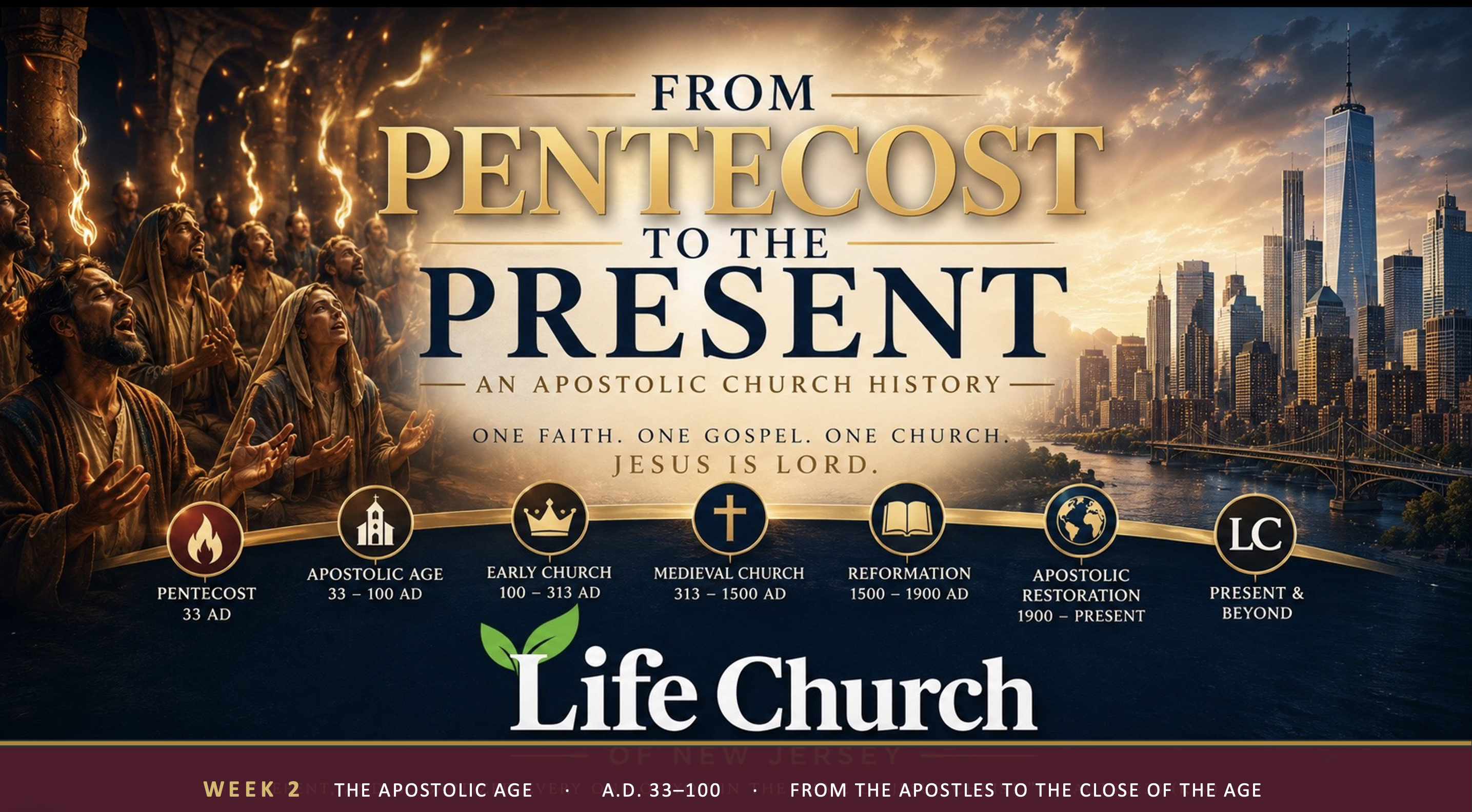
Outline WEEK 2 — THE APOSTOLIC AGE (A.D. 33–100)
June 2026
📖 PASTOR'S CORNER
This week in our History of the Christian Church series, we step into one of the most powerful and costly seasons the church has ever known — The Apostolic Age (A.D. 33–100).
When the book of Acts closes, the story doesn't end. The apostles carried the gospel to the ends of the earth — and most of them sealed that witness with their blood.
We'll be covering:
✦ Why the Roman Empire turned against the church
✦ The first martyrs — Stephen, James, and the price of witness
✦ Where each of the Twelve went and how they died
✦ A closer look at Peter, Paul, and John
✦ The fall of Jerusalem (A.D. 70) and what it changed
✦ The men who carried the faith into the next generation
To help you follow along and go deeper, I've prepared a student outline you can pick up before service. It includes fill-in-the-blank sections, key scriptures, a reference table for all twelve apostles, and space for your own notes and reflections.
Don't just attend — engage. This history belongs to us.
See you in service!
— Pastor Andrew
CHARA The Joy That Comes from God
June 2026
Here's the Chara — Joy That Comes from God five-day self-study devotional, matching your Fruit Salad devotional's format and branding, with the CHARA / χαρά masthead and the full-KJV-plus-context style you asked for.
The five movements of the study became the five days, each on a single page:
Day 1 — Two Words: Happiness and Joy (Galatians 5:22-23; Psalm 16:11): hap vs. chara, thermometer vs. thermostat.
Day 2 — Two Perspectives: His Way, Not the World's (Ecclesiastes 2:11; Habakkuk 3:17-18): Solomon's "vanity" vs. Habakkuk's "yet."
Day 3 — The Source: Joy from the Holy Ghost (Romans 14:17; John 7:38-39): the well installed on the inside.
Day 4 — The Test: Joy in Spite of It All (Acts 16:25; Psalm 30:5): midnight in the jail; "I still have joy."
Day 5 — The Overflow: Joy That Spills Out (1 Peter 1:8; Nehemiah 8:10): joy unspeakable as strength and witness.
Capstone — Refill the Well: a three-question self-check with journaling space, Psalm 51:12, the centered declaration "In spite of everything — I still have joy," and a closing prayer with the Philippians 4:4 charge.
Each day carries the full KJV reading with a brief Context: note, two reflection paragraphs in a warm second-person voice, a Search Your Heart question with ruled journaling lines, a one-line takeaway, and an original written prayer. The cover anchors on John 15:11 ("that your joy might be full").
Showing 1–24 of 34